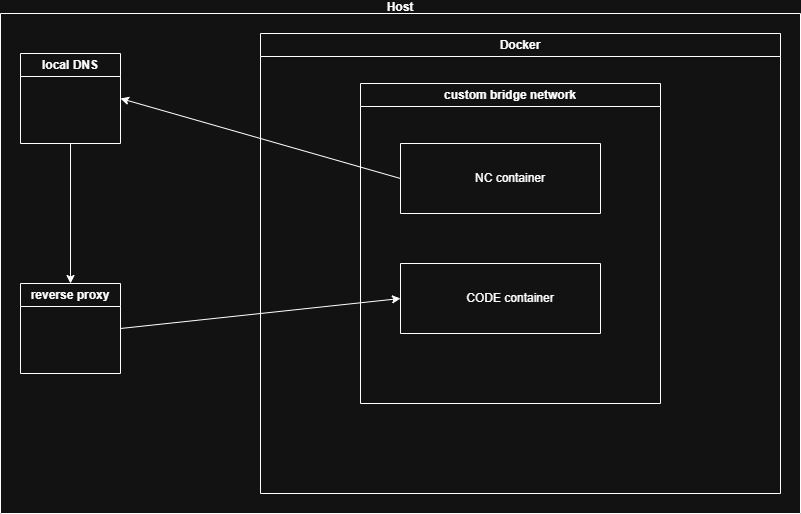
Support intro
Sorry to hear you’re facing problems. 
The community help forum (help.nextcloud.com) is for home and non-enterprise users. Support is provided by other community members on a best effort / “as available” basis. All of those responding are volunteering their time to help you.
If you’re using Nextcloud in a business/critical setting, paid and SLA-based support services can be accessed via portal.nextcloud.com where Nextcloud engineers can help ensure your business keeps running smoothly.
Getting help
In order to help you as efficiently (and quickly!) as possible, please fill in as much of the below requested information as you can.
Before clicking submit: Please check if your query is already addressed via the following resources:
- Official documentation (searchable and regularly updated)
- How to topics and FAQs
- Forum search
(Utilizing these existing resources is typically faster. It also helps reduce the load on our generous volunteers while elevating the signal to noise ratio of the forums otherwise arising from the same queries being posted repeatedly).
Some or all of the below information will be requested if it isn’t supplied; for fastest response please provide as much as you can. 
The Basics
- Nextcloud Server version (e.g., 29.x.x):
32.0.1
- Operating system and version (e.g., Ubuntu 24.04):
Docker/Linux/Synology
- Web server and version (e.g, Apache 2.4.25):
Apache within commuinity NC container
- Reverse proxy and version _(e.g. nginx 1.27.2)
Synology NGINX RP
- PHP version (e.g, 8.3):
- 8.3.27
- Is this the first time you’ve seen this error? (Yes / No):
Yes
- When did this problem seem to first start?
at installation
- Installation method (e.g. AlO, NCP, Bare Metal/Archive, etc.)
Docker Compose
- Are you using CloudfIare, mod_security, or similar? (Yes / No)
no
Summary of the issue you are facing:
I try to set up Nextcloud with basic services inside Docker (AIO is not working for me).
Nextcloud is already up and running, now I added Collabora. The Container is running and prompts that it is ready to accept connections.
When I try to add the office server in the NC admin settings it first gets a green message, that turns into a red message after a few seconds.
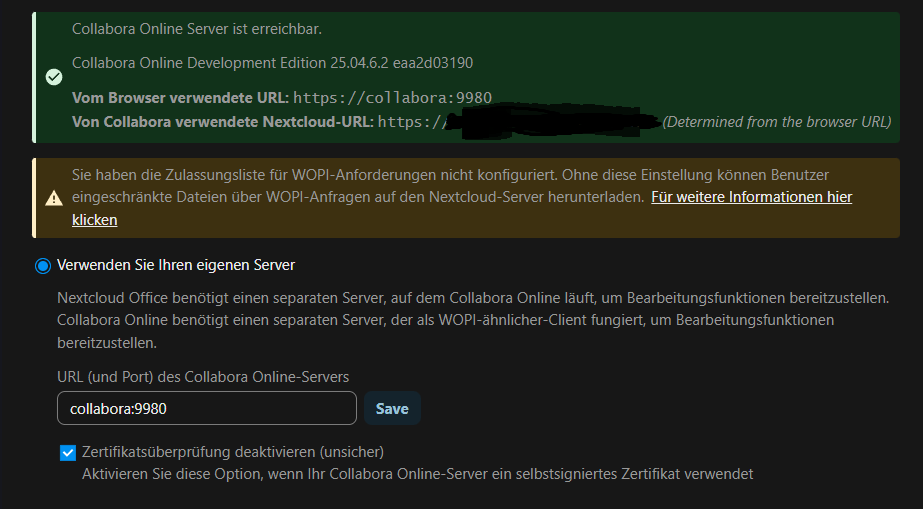
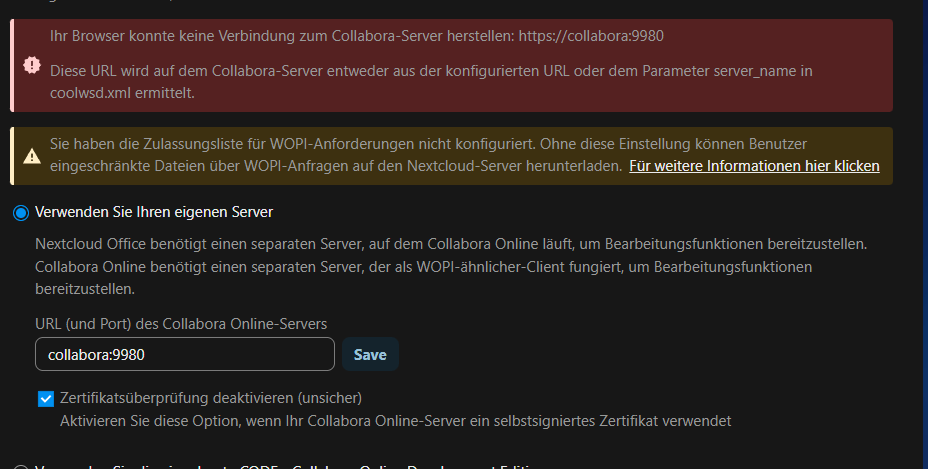
Steps to replicate it (hint: details matter!):
-
Enter the collabora hostname (collabora container name)
-
press save
-
wait
as both containers run in the same docker network, the container is usually accessible via the container name, though I also tried to add the IP of the container and it didn’t work either.
Log entries
Nextcloud
Please provide the log entries from your Nextcloud log that are generated during the time of problem (via the Copy raw option from Administration settings->Logging screen or from your nextcloud.log located in your data directory). Feel free to use a pastebin/gist service if necessary.
none in the logfile, error message in web interface see screenshot above
Web Browser
If the problem is related to the Web interface, open your browser inspector Console and Network tabs while refreshing (reloading) and reproducing the problem. Provide any relevant output/errors here that appear.
see screeshots above
Configuration
Docker Compose
services:
  mariadb:
    image: mariadb:11.5.2
    container_name: nextcloud_mariadb
    restart: unless-stopped
    networks:
      - nextcloud
    volumes:
      - ./mariadb:/var/lib/mysql
    environment:
      - MARIADB_ALLOW_EMPTY_ROOT_PASSWORD=1

  redis:
    image: redis:alpine
    container_name: nextcloud_redis
    restart: unless-stopped
    command: redis-server --requirepass ***REMOVED SENSITIVE VALUE***
    networks:
      - nextcloud

  collabora:
    image: collabora/code:latest
    container_name: collabora
    restart: unless-stopped
    networks:
      - nextcloud
    environment:
      - "dictionaries=en_US,de_DE"
      - "aliasgroup1=https://***REMOVED SENSITIVE VALUE***:443,https://***REMOVED SENSITIVE VALUE***.net:443"
      - "username=***REMOVED SENSITIVE VALUE***"
      - "password=***REMOVED SENSITIVE VALUE***"
      - "extra_params=--o:security.seccomp=false --o:security.capabilities=false --o:ssl.enable=false --o:ssl.termination=true"

  nextcloud:
    image: nextcloud:32.0.1
    container_name: nextcloud_app
    depends_on:
      mariadb:
        condition: service_started
      redis:
        condition: service_started
    restart: unless-stopped
    ports:
      - 81:80
    links:
      - mariadb
      - redis
      - collabora
    networks:
      - nextcloud
    volumes:
      - ./apps:/var/www/html/custom_apps
      - ./config:/var/www/html/config
      - ./data:/var/www/html/data
      - ./nextcloud:/var/www/html
      - ./themes:/var/www/html/themes/custom
      - /volume1/photo/Test:/test
    environment:
      - PHP_MEMORY_LIMIT=4048M
      - PHP_UPLOAD_LIMIT=4048M
      - TRUSTED_PROXIES=192.168.13.201
      - OVERWRITEHOST=***REMOVED SENSITIVE VALUE***
      - OVERWRITEPROTOCOL=https
      - OVERWRITECLIURL=https://***REMOVED SENSITIVE VALUE***
      - REDIS_HOST=redis
      - REDIS_PORT=6379
      - REDIS_HOST_PASSWORD=***REMOVED SENSITIVE VALUE***

networks:
  nextcloud:
    name: nextcloud
    driver: bridge
Nextcloud
The output of occ config:list system or similar is best, but, if not possible, the contents of your config.php file from /path/to/nextcloud is fine (make sure to remove any identifiable information!):
{
    "system": {
        "htaccess.RewriteBase": "\/",
        "apps_paths": [
            {
                "path": "\/var\/www\/html\/apps",
                "url": "\/apps",
                "writable": false
            },
            {
                "path": "\/var\/www\/html\/custom_apps",
                "url": "\/custom_apps",
                "writable": true
            }
        ],
        "overwritehost": "***REMOVED SENSITIVE VALUE***",
        "overwriteprotocol": "https",
        "overwrite.cli.url": "***REMOVED SENSITIVE VALUE***",
        "trusted_proxies": "***REMOVED SENSITIVE VALUE***",
        "upgrade.disable-web": true,
        "instanceid": "***REMOVED SENSITIVE VALUE***",
        "passwordsalt": "***REMOVED SENSITIVE VALUE***",
        "secret": "***REMOVED SENSITIVE VALUE***",
        "trusted_domains": [
            "***REMOVED SENSITIVE VALUE***"
        ],
        "datadirectory": "***REMOVED SENSITIVE VALUE***",
        "dbtype": "mysql",
        "version": "32.0.1.2",
        "dbname": "***REMOVED SENSITIVE VALUE***",
        "dbhost": "***REMOVED SENSITIVE VALUE***",
        "dbtableprefix": "oc_",
        "memcache.local": "\\OC\\Memcache\\APCu",
        "memcache.distributed": "\\OC\\Memcache\\Redis",
        "memcache.locking": "\\OC\\Memcache\\Redis",
        "redis": {
            "host": "***REMOVED SENSITIVE VALUE***",
            "password": "***REMOVED SENSITIVE VALUE***",
            "port": 6379
        },
        "mysql.utf8mb4": true,
        "dbuser": "***REMOVED SENSITIVE VALUE***",
        "dbpassword": "***REMOVED SENSITIVE VALUE***",
        "installed": true,
        "maintenance": false
    }
}