I have no support/technical question and have seen the support category. (Be aware that direct support questions will be deleted.)
on
Which general topic do you have
Gents. I am all in for pushing the move to euro-office. In fact I was looking into migrating from the CODE based nextcloud office solution in my personal setup at the moment. However, as this requires the euro-office document server to be installed, it is not even close to be ready for release for the majority of users. Especially because the Nextcloud Office app is forcefully changed to euro-office and the easy setup of the PHP based CODE based solution, is not available anymore, and to install the Euro-Office document server, you need to either build and make it or deploy a docker image. As such, this excludes the segment of users and admins that do not use docker (bare metal, VM, Linux Containers, Jails etc). As such, the deployment of an Euro-Office document server is in its first release, which compared to the CODE based solution, is bare minimum and documentation is scarce still.
For the community before switching, we probably have to wait for a first version so we can test and give feedback. Perhaps there are other resources where you can get more involved with the developments, and also get your hands on some early releases.
If anything, Euro-Office seems more likely to replace ONLYOFFICE than Collabora. Whether Euro-Office will eventually be rebranded as Nextcloud Office once it’s fully mature, while Collabora continues under its own name, I don’t know. But either way, at the moment, I don’t see anything suggesting that users will no longer be able to use Collabora.
As for when Euro-Office will be available in the app store and production-ready, or whether there will be a built-in server package similar to the Built-in CODE Server or the ONLYOFFICE Document Server, I have no idea. But I’m sure it’ll be prominently announced once they’re ready. Maybe we’ll even hear something about it today during the Nextcloud Hub 26 Spring launch event?
When seqarching for Nextcloud office to “switchback” to the CODE based “nextcloud office” the app you find is the eurooffice one and not the richdocuments one. That can be found by following the link in the Collabora Online - Built-in CODE Server app description on apps.nextcloud.com. Nextcloud office has been renamed to Nextcloud Office (Collabora) but searching for Nextcloud office under apps leads to this: Nextcloud Office - Apps - App Store - Nextcloud
So it feels neforced, even though it is not. Sorry for that part. But for the community average user, it is not that easy to avoid mixing the things up. I, for one, was used to the “old” Nextcloud Office app, so it was confusing why it did not work when I thought I had reverted back and re-installed again.
Actually it was easier for me to use occ to ensure I got the richdocuments and richdocumentscode specifically.
Yeah, I just saw that they changed “Nextcloud Office” to “Nextcloud Office (Collabora)” in the app store and “Nextcloud Office” (without the Collabora addition) is now for Euro-Office.
I couldn’t find a Euro-Office document server app in the app store though, so I guess the Docker container is currently the only way to install it, or Nextcloud AIO, of course.
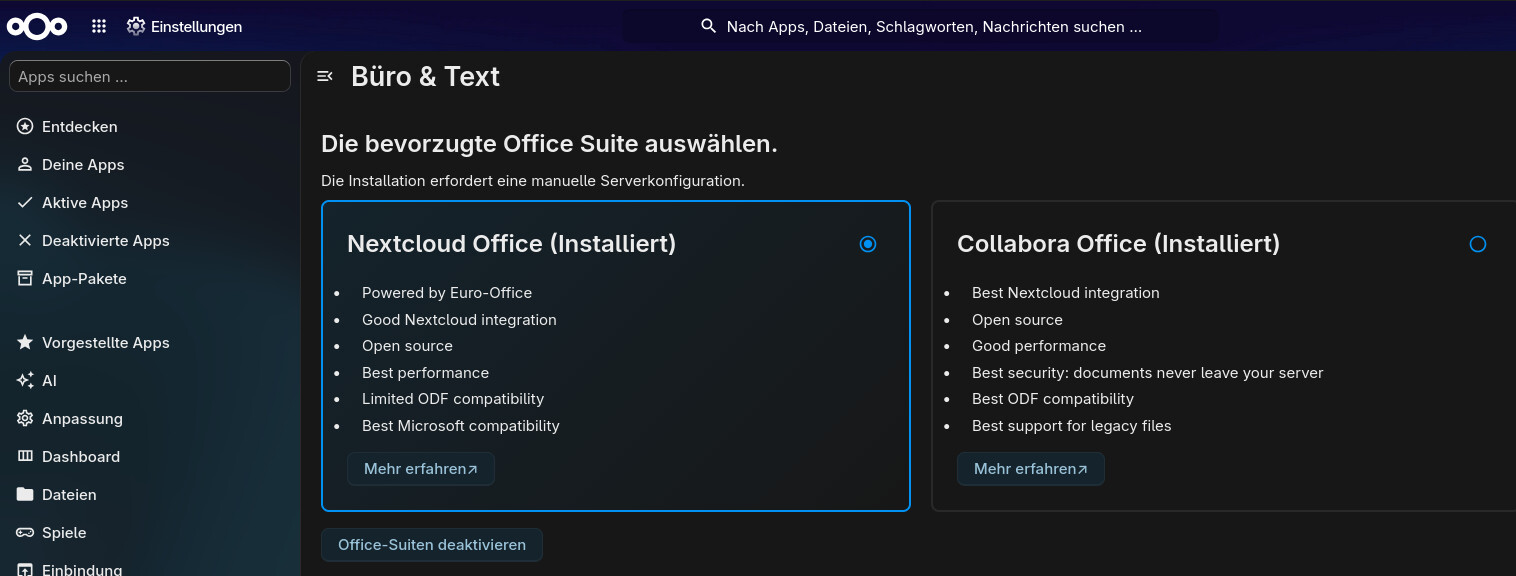
By the way, in the App Store of Nextcloud 34 itself, in the Office & Text category, they’ve integrated a new section right at the top that lets you easily switch between the two:
However, it seems that this is only for the connector apps and that you still need to install the respective document server separately: either the Collabora Docker container, the Built-in CODE Server (richdocumentscode), or, in the case of Euro-Office, the Docker container that I linked to above (at least for now).
Are you talking about Euro Office as the app that is supposed to make us less dependent of the big tech Office (Dollar Office), but is still based on the big tech document formats, in contrast to Libre Office which is based on new and truly open doc formats that are now also supported by big tech Office?
Fortunately, however, you are free to choose whichever solution you want to use, and both (Collabora and Euro-Office) have their pros and cons.
Collabora is based on LibreOffice and therefore offers the best possible OpenDocument Format (ODF) support.
EuroOffice is a fork of ONLYOFFICE, whose primary goal was to provide the best possible compatibility with Microsoft Office formats, and therefore generally works better with OOXML formats.
However, both support both formats. Also, the project is still relatively young, so improvements regarding ODF will certainly be made over time.
Thanks for pointing at OnlyOffice. I looked it up on Wikipedia, but because this forum is not about debates on conspiracies and politics I will shut up now.
Yeah, I mean, I don’t necessarily disagree. In the long term, open file formats are definitely an important factor in achieving true independence from big tech companies.
On the other hand, Microsoft Office compatibility remains a key factor and a prerequisite for many organizations to even consider moving away from Microsoft 365. So I’d say that both OOXML compatibility and support for open formats are important.
The former is needed to get people and organizations away from the Microsoft ecosystem in the first place, while the latter is important for long-term sustainability and independence.
So, I think it’s wise to take a pragmatic approach if you want to convince the broader market. Having principles is important, but ultimately these are tools to get work done, and how well they enable that, along with the associated costs. will usually be weighted more heavily by for-profit organizations than ideological or even moral considerations.
The only thing I can add is that I have actually programmed with the C# libraries for Open Office, from Microsoft for their OOXML formats, and “Office Open” for the LibreOffice ODF formats, and I will never forget how bizar complex the former, and how elegant and simple the latter was.
I understand Microsoft, as for them this is an existential battle.
As for usability, the European Union has made laws that forced Microsoft to read and write the LibreOffice document formats without error messages. So let’s not fall in the M$ trap.
They are already working on improving ODF support in Euro-Office, but these things don’t happen overnight. And in my opinion, it’s still better if someone moves to a European-hosted or self-hosted solution that isn’t provided by Big Tech, even if they’re still using Microsoft formats for the time being, than staying with Microsoft 365. And for people or organizations that already primarily use ODF, there’s always Collabora, which is based on LibreOffice.
And whether you like it or not, Microsoft Office compatibility is an important requirement for many organizations. Companies are not going to convert all of their templates and workflows to ODF overnight just because the EU wants to reduce dependence on the US. And many companies don’t operate solely within the EU anyway. They do business globally, and if their customers, suppliers, or partners use Microsoft Office, they can’t simply force them all to switch to ODF.
What I mean by pragmatic is that you offer solutions today that are usable in practice and allow organizations to actually start moving away from Microsoft 365 now. Ignoring real-world requirements such as Microsoft Office compatibility, which many organizations simply need and expect, or waiting until ODF support in Euro-Office is flawless, or until the Document Foundation revives LibreOffice Online to a point where it perhaps becomes a realistic alternative, isn’t going to help with that.
Sometimes you need to take one step at a time to reach the end goal. Trying to force what you consider to be the perfect solution with a sledgehammer approach is rarely effective and can often be counterproductive.
Yeah, but ONLYOFFICE, and therefore Euro-Office as well, processes documents internally in OOXML, and Microsoft Office compatibility has always been one of ONLYOFFICE’s main selling points. How good, or how much better, that compatibility actually is in practice compared to Collabora, especially in edge cases, is something I can’t really judge. It certainly won’t be perfect, though; I mean, not even Microsoft Office itself is always perfectly compatible with its own formats.
But compatibility is only one aspect. The user interface is also closer to Microsoft Office, and there are a number of technical differences in how the server backends work, each with their own pros and cons. For example, Collabora is essentially rendering documents remotely for the browser, whereas Euro-Office relies more heavily on client-side rendering and processing in the browser. The communication between the browser and the backend is also implemented differently.
Either way, I think it’s great that there is now a second fully open-source solution alongside Collabora. Having choice is always a good thing, in my opinion.