- Nextcloud Server version (e.g., 29.x.x):
33.0.3
- Operating system and version (e.g., Ubuntu 24.04):
OpenSUSE Leap 16.0
- Web server and version (e.g, Apache 2.4.25):
Nginx
- Reverse proxy and version _(e.g. nginx 1.27.2)
Nginx
- PHP version (e.g, 8.3):
n/a
- Is this the first time you’ve seen this error? (Yes / No):
No
- When did this problem seem to first start?
n/a
- Installation method (e.g. AlO, NCP, Bare Metal/Archive, etc.)
Bare metal
- Are you using CloudfIare, mod_security, or similar? (Yes / No)
No
Summary of the issue you are facing:
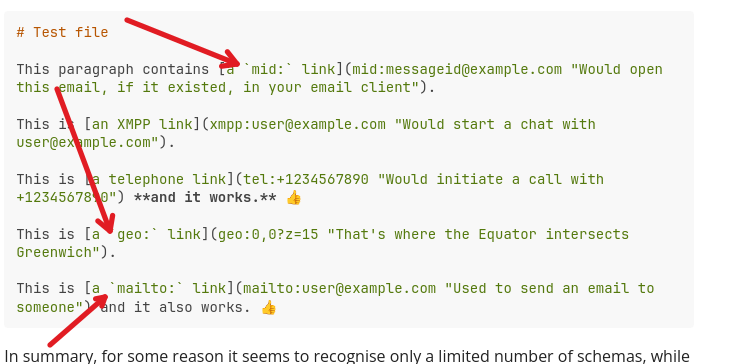
Markdown viewer corrupts URLs mid: schemas.
These links are supported in recent Thunderbird versions and are an extremely handy way to link to specific emails in a way that both the sender and any recipients can use to quickly open the email.
Steps to replicate it (hint: details matter!):
- Log into a Nextcloud instance in which you are able to create Markdown files and which has the Markdown viewer enabled (which it is by default)
- Create a Markdown file with a
mid:URL, e.g.:
# Test file

This paragraph contains [a `mid:` link](mid:messageid@example.com "Would open this email, if it existed, in your email client").
- Open the test Markdown file in the web frontend
- Notice that the URL has been corrupted and now points to the Markdown file itself. It does not seem to overwrite the actual link in the file, but it does not render it correctly in the HTML either.
Log entries
Nextcloud
n/a
Web Browser
n/a
Web server / Reverse Proxy
n/a
Configuration
Nextcloud
The output of occ config:list system
{
    "system": {
        "instanceid": "***REMOVED SENSITIVE VALUE***",
        "passwordsalt": "***REMOVED SENSITIVE VALUE***",
        "secret": "***REMOVED SENSITIVE VALUE***",
        "trusted_domains": [
        ],
        "datadirectory": "***REMOVED SENSITIVE VALUE***",
        "dbtype": "pgsql",
        "memcache.local": "\\OC\\Memcache\\Redis",
        "memcache.locking": "\\OC\\Memcache\\Redis",
        "redis": {
            "host": "***REMOVED SENSITIVE VALUE***",
            "port": 6379
        },
        "auth.bruteforce.protection.enabled": false,
        "version": "33.0.3.2",
        "logtimezone": "UTC",
        "installed": true,
        "mail_smtpmode": "smtp",
        "maintenance": false,
        "theme": "",
        "loglevel": 3,
        "appstore.experimental.enabled": false,
        "mail_from_address": "***REMOVED SENSITIVE VALUE***",
        "mail_domain": "***REMOVED SENSITIVE VALUE***",
        "mail_smtpauth": 1,
        "mail_smtpauthtype": "LOGIN",
        "mail_smtphost": "***REMOVED SENSITIVE VALUE***",
        "mail_smtpport": "465",
        "mail_smtpname": "***REMOVED SENSITIVE VALUE***",
        "mail_smtppassword": "***REMOVED SENSITIVE VALUE***",
        "mail_smtpdebug": false,
        "updater.release.channel": "stable",
        "dbname": "***REMOVED SENSITIVE VALUE***",
        "dbhost": "***REMOVED SENSITIVE VALUE***",
        "dbuser": "***REMOVED SENSITIVE VALUE***",
        "simpleSignUpLink.shown": false,
        "app_install_overwrite": [
            "calendar",
            "tasks",
            "files_readmemd",
        ],
        "mail_sendmailmode": "smtp",
        "mail_smtpsecure": "ssl",
        "maintenance_window_start": 1,
        "default_locale": "en_GB",
        "skeletondirectory": "",
        "templatedirectory": "",
        "user_oidc": {
            "oidc_provider_bearer_validation": true
        }
    }
}